Your Employer Shouldn’t Own Your Reputation
Aug 23, 2026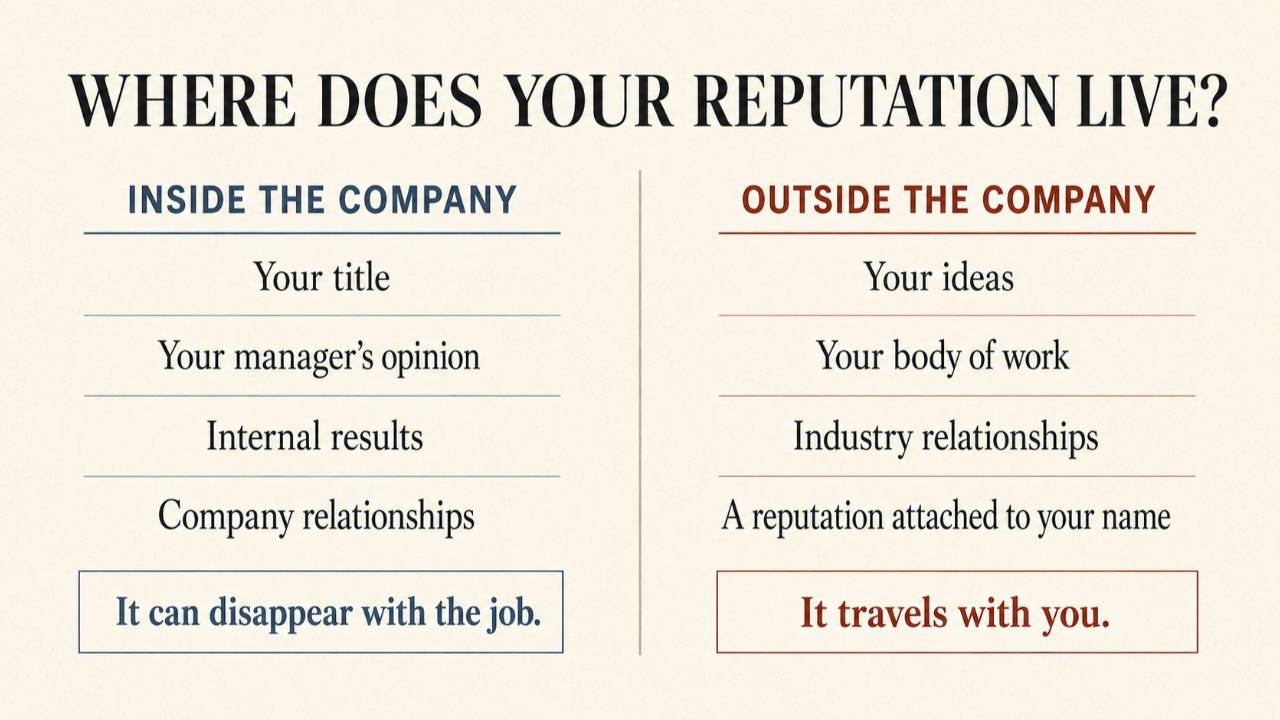
You open LinkedIn and see another one…
Someone has been laid off after eight years. They’re shocked, devastated and “open to work.”
The post usually starts with how grateful they are. Then comes the list of everything they gave the company. The teams they built, the results they delivered, the evenings they worked through.
And somewhere near the end, the tone changes.
Please keep me in mind if you hear of anything.
You might not know this person, but you feel it. Because they did what most of us were told to do.
They worked hard. They became good at their job. They stayed loyal.
And the company still let them go.
Amazon cut approximately 16,000 corporate roles in January. Microsoft announced around 4,800 cuts in July. Cisco, Intuit and other major employers have also reduced their workforces while moving more investment towards AI.
In the US, employers announced more than 443,000 job cuts during the first half of 2026. June was much quieter than May, so the numbers are not climbing endlessly. But AI has now been the leading reason given for job cuts for four consecutive months.
In the UK, unemployment stood at 4.9% in the latest available figures. Vacancies had fallen below their pre-pandemic level, and the number of payrolled employees was down by 138,000 over the year to April.
Those are the numbers.
But the numbers don’t show you the moment someone tries to log in and realises their access has already been removed.
They don’t show you the conversation at home that evening. The mortgage payment. The visa tied to the job. The school fees. The quiet panic of looking at your CV and wondering whether fifteen years of experience still look valuable without the company name beside them.
That’s what people are scared of.
And I think they’re right to be.
I know what it means to let a company hold your reputation
I spent six and a half years in corporate.
At one point, I was doing my job and much of my manager’s. He would come to my desk when nobody was watching and tell me he had no idea what to do.
“Can you handle it?'“
And I would.
Then I would sit in meetings and watch him present the work.
I hated it, but I also accepted it. I thought that was the price of moving forward. Keep your head down. Be useful. Eventually, the right people will notice.
But useful people are very easy to keep in the background. They solve the problems. They don’t necessarily receive the credit.
The work becomes part of the company’s success. Your contribution becomes a bullet point on your CV.
That is the trap.
You can spend years building an excellent professional reputation inside a company and still be almost unknown outside it.
Your manager knows you. Your team knows you. A handful of clients might know you.
Then the job disappears and you discover that the wider market has no idea who you are.
You have to introduce yourself from the beginning at the exact moment your confidence has been hit the hardest.
The old promise doesn’t feel believable anymore
For a long time, corporate employment offered a deal that made sense.
You gave the company your time, experience and loyalty. The company gave you income, progression and a reasonable expectation of stability.
Of course, layoffs existed. Companies failed. Industries changed.
But now even successful companies are cutting established roles while hiring different people somewhere else.
Thomson Reuters, for example, is reducing parts of its engineering workforce while planning to create more than 250 senior and AI-focused engineering roles.
The company is not simply removing jobs. It is making a new judgement about which people and skills it will need next.
That is what makes this moment so uncomfortable.
You can be experienced, hardworking and genuinely valuable. The company can still decide it needs a different type of value.
It doesn’t mean your work was bad.
It means the decision was never fully yours.
This is why I believe in personal brand
I know the phrase makes some people uncomfortable.
They picture influencers filming their breakfast and telling strangers five things they learned before 7 a.m.
I don’t think corporate professionals need to do that.
I think they need to stop allowing one employer to be the only place where their value is visible.
If you have spent ten years solving difficult problems, you have something to say.
If you have watched the same mistake happen across three companies, you have a perspective.
If people regularly come to you when something goes wrong, there is a reason.
But if all of that stays inside meetings, private messages and conversations with colleagues, your company benefits from your thinking while the outside world never sees it.
A personal brand gives that thinking somewhere to live.
It means that people outside your company begin to associate your name with something. They understand what you notice, what you know and how you make decisions.
Maybe that audience is 500 people. Maybe it becomes 10,000.
The number matters much less than who those people are and what they know you for.
Ten thousand people who vaguely recognise your face will not save your career.
A few hundred people who understand your value might change it.
It won’t make you untouchable
Having a personal brand will not prevent a layoff.
It won’t guarantee a job. It won’t make clients appear the day after you post on LinkedIn. And it won’t remove the fear of losing a stable income.
But imagine two people leaving the same company on the same day.
One begins by updating their CV and telling the market who they are.
The other has spent the last two years showing people how they think. They have former colleagues, industry connections and readers who already understand their expertise. There is a body of work attached to their name.
Both might struggle.
But only one of them is starting from silence.
That is the missing layer of security I’m talking about.
Your salary comes from the company. Your title comes from the company. Access to the audience, clients and internal relationships may also come from the company.
Your reputation should not.

Build it while everything still feels fine
Most people start thinking about visibility when something has already gone wrong.
They were overlooked for a promotion. Their industry started cutting jobs. A manager they trusted left. Suddenly, they need other people to know who they are.
But that is the hardest moment to begin.
You are trying to write confidently while privately panicking. You need the content to produce something quickly. Every post that gets little response feels like more evidence that nobody cares.
Building before you need it feels completely different.
You have time to find your voice. You can publish because you have something worth saying, without needing every piece to generate an opportunity. People get to know you gradually.
And if the difficult day eventually comes, you are still allowed to be frightened.
You just won’t be invisible as well.
I write about how AI and the changing corporate world are affecting our careers, and how experienced professionals can build a reputation that doesn’t disappear with their job.
Subscribe if that is something you are thinking about too.